See how ZHR actuators perform in demanding applications—from 7-DOF robot arm research platforms to surgical exoskeleton deployments. Real data, real results.
A lightweight, fully open-source 7-DOF desktop manipulator (6 arm joints + 1 end-effector gripper) powered by ZHR-P series integrated joint motors, enabling CAN communication, ROS2 control, and real-time kinematic solving.
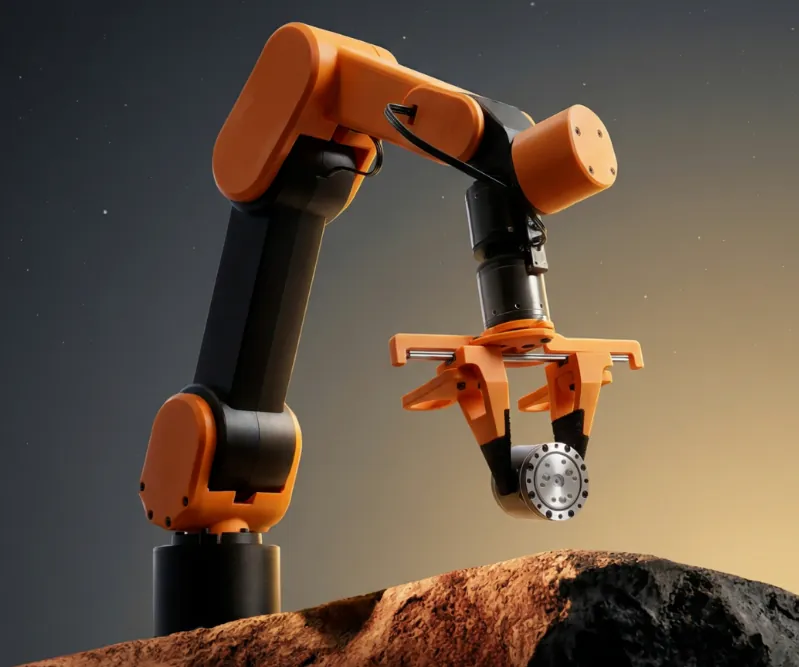
The research team needed a lightweight desktop robot arm for ROS2 development and multi-arm协同 control experiments. Key requirements included: low weight (<2kg per joint), high torque density, native CAN 2.0 communication at 1 Mbps, and compatibility with MoveIt2 motion planning stack. Traditional industrial actuators were too heavy and expensive for this research platform.
The team selected a hybrid ZHR-P series configuration: Joints J1–J3 (base, shoulder, elbow) use ZHR-P03 actuators (±14 Nm peak torque, ±33 rad/s max speed), while J4–J7 (wrist + gripper) use ZHR-P05 actuators (±6 Nm peak torque, ±50 rad/s max speed). All joints feature integrated motor + planetary gearbox + driver + 14-bit dual encoders in a single compact housing. Communication via SocketCAN (CAN 2.0 Extended Frame, 1 Mbps).
| Joint | Actuator Model | Peak Torque | Max Speed | Position Range | Weight |
|---|---|---|---|---|---|
| J1 (Base) | ZHR-P03 | ±14 Nm | ±33 rad/s | ±160° | 310g |
| J2 (Shoulder) | ZHR-P03 | ±14 Nm | ±33 rad/s | ±180° | 310g |
| J3 (Elbow) | ZHR-P03 | ±14 Nm | ±33 rad/s | ±230° | 310g |
| J4 (Wrist 1) | ZHR-P05 | ±6 Nm | ±50 rad/s | ±90° | 280g |
| J5 (Wrist 2) | ZHR-P05 | ±6 Nm | ±50 rad/s | ±90° | 280g |
| J6 (Wrist 3) | ZHR-P05 | ±5.5 Nm | ±50 rad/s | ±90° | 280g |
| J7 (Gripper) | ZHR-P05 | ±5.5 Nm | ±50 rad/s | ±90° | 280g |
A passive lower-limb exoskeleton deployed in hospital operating rooms to reduce surgeon fatigue during prolonged standing surgeries, utilizing ZHR-H series harmonic actuators for precision joint support.
Surgeons routinely stand for 4�? hours during complex procedures (vascular surgery, orthopedic operations, neurosurgery), leading to severe lower-limb fatigue, musculoskeletal disorders, and degraded surgical precision over time. Traditional solutions (anti-fatigue mats, periodic sitting) were insufficient for sterile operating room environments. The need: a wearable support device that reduces physical load without restricting range of motion or compromising sterile protocol.
The exoskeleton integrates ZHR-H series harmonic actuators at the hip and knee joints, providing three operating modes: (1) Sitting-while-standing mode—the exoskeleton supports the surgeon's weight in a semi-seated posture; (2) Dynamic support mode—active assistance during leg movement transitions; (3) Passive lock mode—rigid support for prolonged static standing. The harmonic reducer's <20 arcsec backlash ensures smooth, vibration-free support critical for surgical precision.
Mayo Clinic Pilot (Vascular Surgery): The exoskeleton was evaluated during vascular procedures requiring prolonged standing. Surgeons reported the device was "nearly compatible with all surgical workflows" with "no reported limitations in range of motion or operational precision." Participants unanimously recommended continued clinical use.
DACH Region Hospitals (Germany/Austria/Switzerland): Early adopters using Ottobock Paexo Shoulder upgraded to the SUITX IX Should Air system. Users reported "noticeable reduction in muscle strain" during surgeries, with the lightweight design and quick don/doff capability being key acceptance factors.
Long-Term Impact: Prolonged use reduces the risk of chronic musculoskeletal disorders (shoulder, lower back, lower limbs), potentially reducing sick leave and improving surgeon career longevity. The exoskeleton serves as an occupational health management tool, helping address the surgical workforce shortage by improving the working environment.
Harmonic reducer technology ensures <20 arcsec backlash, critical for smooth, vibration-free support that doesn't interfere with delicate surgical movements.
High torque density (Nm/kg) enables a wearable form factor that doesn't burden the surgeon—essential for 4�? hour procedures.
Passive exoskeleton architecture requires no batteries or electronics in the sterile field, maintaining full compatibility with OR protocols.
Whether you're building a research robot arm or a medical exoskeleton, our engineering team provides hands-on support from initial design through field deployment.