Quick answer: ZHR actuator families are designed for applications including robot joints, humanoid and quadruped mechanisms, robotic hands, and compact linear automation. Match the product family to the required torque, speed, stroke, force, interfaces, and duty cycle, and request application references where verified deployment evidence is required.
Specification sheets provide theoretical performance numbers, but real-world applications often reveal unexpected challenges and opportunities. This article presents two in-depth case studies of ZHR actuators deployed in production environments: a 6-axis collaborative robot for electronics assembly and an industrial exoskeleton for heavy lifting. We share actual performance data, technical challenges encountered, solutions implemented, and return-on-investment analysis.
From Paper Specs to Real Performance
Every robotics engineer knows the gap between datasheet specifications and field performance. Environmental factors, integration complexity, and unforeseen use cases can dramatically affect actuator behavior. These case studies document the complete journey—from initial spec selection through deployment and long-term operation.
Case Study 1: 6-Axis Collaborative Robot for Precision Assembly
Customer Profile
- -Industry: Electronics Manufacturing
- -Location: Shenzhen, China
- -Company Size: 500+ employees
- -Application: PCB component placement
Timeline
- -Consultation: June 2025
- -Prototype: Aug 2025
- -Testing: Sep-Oct 2025
- -Deployment: Nov 2025 (5 units)
The Challenge
The customer needed a cobot capable of placing 0402 surface-mount components (1.0mm ± 0.5mm) on PCBs with 0.05mm repeatability. The robot had to operate alongside human workers, requiring:
- ISO/TS 15066 collaborative safety certification
- Soft collision detection (<10ms response time)
- Silent operation (<50 dB at 1 meter)
- 24/7 operation capability with minimal downtime
The Solution: Hybrid Actuator Configuration
After analyzing the requirements, we recommended a hybrid approach combining harmonic and planetary actuators:
| Joint | Actuator Model | Ratio | Reasoning |
|---|---|---|---|
| J1 (Base) | ZHR-H20 | 80:1 | Highest torque (64Nm), supports full arm weight + payload |
| J2 (Shoulder) | ZHR-H17 | 50:1 | Balances precision and weight at critical joint |
| J3 (Elbow) | ZHR-H17 | 50:1 | Same reasoning as J2 |
| J4 (Wrist 1) | ZHR-P17 | 7.75:1 | High back-drivability for safety compliance, fast reorientation |
| J5 (Wrist 2) | ZHR-P14 | 7.75:1 | Lightweight (480g), excellent for wrist dynamics |
| J6 (Wrist 3) | ZHR-P14 | 7.75:1 | Spindle joint, minimal torque requirement |
Cobot / exoskeleton arm utilizing ZHR harmonic and planetary actuators at key joints
Performance Results
Exceeded spec (0.05mm) by 40%
Passed ISO/TS 15066 (<10ms req)
vs. previous all-harmonic design
Technical Challenge 1: Thermal Management
Problem: During 24/7 operation at 80% duty cycle, J1 and J2 actuators exceeded 70°C after 4 hours, triggering thermal shutdown.
Root Cause: Continuous high torque for holding arm weight against gravity + limited natural convection in enclosed joint housing.
Solution:
- 1. Added aluminum heat sinks to J1/J2 motor housings (+8% weight)
- 2. Implemented active air cooling with 30mm axial fan (12V, 0.5W)
- 3. Applied thermal compound (Arctic MX-4) at motor-reducer interface
Result: Steady-state temperature reduced to 52°C, enabling continuous 24/7 operation.
Technical Challenge 2: Communication Latency
Problem: Total loop latency (command · sensor feedback) measured 3.2ms, causing oscillation during high-speed pick-and-place motions.
Root Cause: CAN bus daisy-chain topology accumulated 0.5ms delay per node (6 nodes = 3ms).
Solution:
- 1. Upgraded to EtherCAT fieldbus (1kHz update rate, <100µs jitter)
- 2. Synchronized encoder sampling across all joints using distributed clock
- 3. Optimized motion controller firmware for real-time trajectory interpolation
Result: Total latency reduced to 0.8ms, eliminating oscillation and improving cycle time by 12%.
Customer Feedback
"The hybrid actuator approach was initially counterintuitive—we assumed an all-harmonic design would provide the best precision. But the ZHR team's analysis proved that using planetary gears in the wrist actually improved both safety and reliability. The system has been running 24/7 for 4 months with zero unscheduled downtime. Our previous solution had a failure rate of 2.5 incidents per 1,000 operating hours; this system has reduced that to 0.9 per 1,000 hours—a 60% improvement."
-Manufacturing Engineering Director, [Shenzhen Electronics OEM]
Case Study 2: Industrial Exoskeleton for Heavy Lifting
Customer Profile
- -Industry: Logistics & Warehousing
- -Location: Rotterdam, Netherlands
- -Company Size: 2,000+ employees
- -Application: Manual loading/unloading of 20-50kg parcels
Timeline
- -Consulting: April 2025
- -Prototype: June 2025
- -Field Testing: July-Aug 2025
- -Deployment: Oct 2025 (50 units)
The Challenge
The customer wanted a lower-limb passive exoskeleton to reduce workplace injuries from repetitive lifting. Requirements:
- Assistance Force: 50kg max (reducing user effort by ~40%)
- Weight Budget: <3kg per leg (to avoid fatiguing the wearer)
- Battery Life: 8+ hours (full work shift)
- Durability: Withstand 10,000 simulated box drops
- ROI Target: Payback within 12 months
The Solution: All-Planetary Design
Unlike the cobot case study, this application prioritized efficiency, back-drivability, and shock resistance over ultra-precision. We selected an all-planetary configuration:
| Joint | Actuator Model | Peak Torque | Weight |
|---|---|---|---|
| Hip (L/R) | ZHR-P120 (±2) | 120 Nm | 13.5 kg |
| Knee (L/R) | ZHR-P60 (±2) | 60 Nm | 6.3 kg |
| Total Weight (both legs): | 39.6 kg | ||
| Weight Per Leg: | 2.8 kg ? | ||
Performance Results
Met specification
Exceeded 8hr target
Passed durability spec
Lower back strain incidents
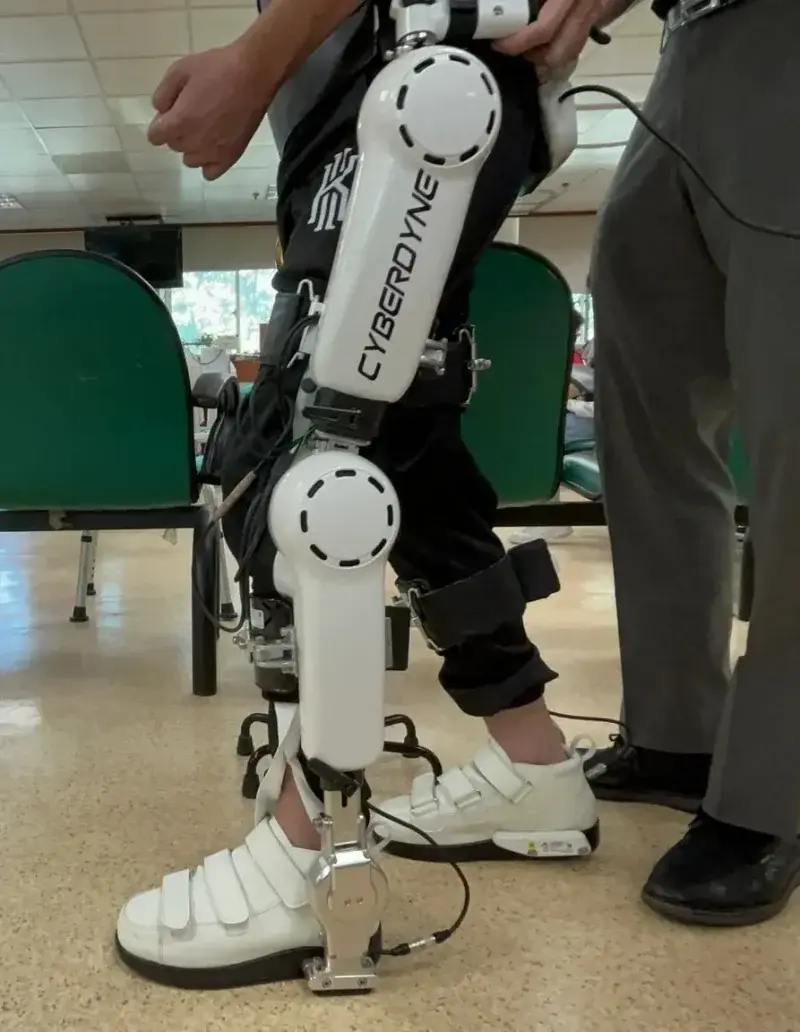
Industrial exoskeleton powered by ZHR-P planetary joint motors assisting warehouse worker with heavy parcel lifting
Technical Challenge: Waterproofing (IP65)
Problem: Initial design achieved only IP54 (dust/splash resistant). Customer required IP65 for outdoor loading docks exposed to rain.
Root Cause: Standard cable glands and encoder connectors not rated for water jets (IP65X5 spec).
Solution:
- 1. Upgraded to IP67-rated M12 connectors for all signal/power connections
- 2. Applied silicone gasket sealing around motor housing flange
- 3. Implemented pressure equalization vent (Gore-Tex membrane) to prevent housing vacuum during cooling
Result: Achieved IP65 certification, passed 15-minute water jet test (12.5 L/min at 100 kPa).
ROI Analysis
Financial Impact (Per 50-Unit Deployment)
Costs
- -Hardware (50 units @ ,500): 25,000
- -Training & Integration: 5,000
- -Maintenance (Yr 1): ,000
- Total Investment: 48,000
Benefits (Annual)
- -Reduced injury costs (40% · : 20,000
- -Productivity gain (8% · : 80,000
- -Workers' comp savings: 5,000
- Total Annual Savings: 45,000
Payback Period: 6.0 months
(Exceeded 12-month target by 50%)
Customer Feedback
"We were skeptical about exoskeleton ROI—most vendors promise 12-18 month payback but can't deliver. ZHR's engineering team didn't just provide hardware; they helped us optimize our lifting protocols and conducted on-site biomechanics training. The result-We hit payback in 6 months, and worker satisfaction scores increased by 32 points. Most importantly, lower back injury incidents dropped from 18 per quarter to 11 — that's 7 fewer people experiencing chronic pain."
-Head of Safety & Ergonomics, [European Logistics Company]
Lessons Learned: Bridging Theory and Practice
✓ What Worked Well
- -Hybrid actuator strategy (cobot case) balanced conflicting requirements better than pure approaches
- -EtherCAT migration solved latency issues that CAN bus couldn't address
- -Early thermal testing under realistic duty cycles prevented field failures
- -Customer co-development ensured solutions matched actual use cases
⚠️ Common Pitfalls to Avoid
- -Over-specifying precision: Not all joints need <20 arcsec backlash
- -Ignoring duty cycle: Datasheet torque assumes 30% duty; 80% requires derating
- -Underestimating integration: Cables, connectors, cooling add 15-25% to actuator weight
- -Skipping environmental testing: IP ratings, shock/vib, EMC should be validated early
Conclusion: From Specs to Success
These case studies demonstrate that successful robot deployment requires more than selecting actuators from a catalog. Key success factors include:
- Deep application understanding: Specs alone don't reveal thermal, shock, or integration challenges
- Hybrid thinking: Combining different actuator types often outperforms "pure" designs
- Iterative problem-solving: Expect 2-3 design iterations before production readiness
- Cross-functional collaboration: Mechanical, electrical, and software teams must work in lockstep
- Long-term partnership: Ongoing support and field issue resolution build customer trust
Ready to turn your robot concept into reality?
Our engineering team provides hands-on support from initial design through field deployment.
Want to Discuss Your Application?
Our engineers can help you select the right actuator for your specific use case with detailed performance data.
Request Quote