Collaborative Robots (Cobots) have revolutionized manufacturing by sharing workspaces directly with human operators. However, removing physical safety barriers introduces a profound engineering challenge: the robot must instantaneously detect and yield to human contact. This requirement places unprecedented demands on the robot joint motor, specifically mandating zero-backlash actuators.
1. The Role of Force Control in Cobot Safety
Traditional industrial robots use position control. They move from Point A to Point B regardless of what is in the way. Cobots, conversely, rely heavily on impedance control and force/torque sensing.
When a cobot arm strikes a human, the control system must detect the spike in motor current (or joint torque sensor data) and reverse the joint's direction within milliseconds. For this mathematical model to work accurately, the physical connection between the motor, the speed reducer, and the robot link must be infinitely rigid.
2. What is Backlash and Why is it Dangerous?
Backlash is the "play" or mechanical clearance between mating gear teeth. In standard planetary or spur gearboxes, this gap is necessary for lubrication and to prevent jamming.
However, in a collaborative robot, backlash creates a "dead zone" in the control loop:
- Loss of Transparency: When the motor reverses direction, the rotor turns for a fraction of a degree before engaging the output shaft. The force sensor reads zero resistance, tricking the software into thinking the collision has ended.
- Instability and Oscillation: High-gain force control loops will overcompensate when passing through the backlash dead zone, causing the robotic arm to violently vibrate or "chatter."
- Positional Inaccuracy: At the end of a 1-meter cobot arm, a mere 5 arcminutes of backlash at the shoulder joint translates to roughly 1.5 millimeters of uncontrolled sway at the tool center point (TCP).
3. Strain Wave Gears: The Zero-Backlash Standard
To eliminate backlash, the industry standard for collaborative robots is the Strain Wave Gear (commonly known as a Harmonic Reducer).
How it Achieves Zero Backlash
Unlike traditional gears that mesh tangentially, a strain wave gear relies on the elastic deformation of a thin metal cup (the flexspline). The elliptical wave generator forces the flexspline into constant, pre-loaded contact with the circular spline at two opposing points. Because the teeth are essentially wedged together elastically, mechanical clearance is driven to zero (typically <20 arcseconds).
This continuous pre-load ensures that the moment the frameless torque motor applies reverse torque, 100% of that force is immediately transferred to the joint, allowing the impedance control algorithms to react instantly to human contact.
4. Integrated Joint Modules for Cobots
Building a zero-backlash joint from scratch is notoriously difficult. Misaligning a harmonic reducer by even a few microns can destroy the flexspline. This is why leading cobot manufacturers are shifting toward integrated joint modules.
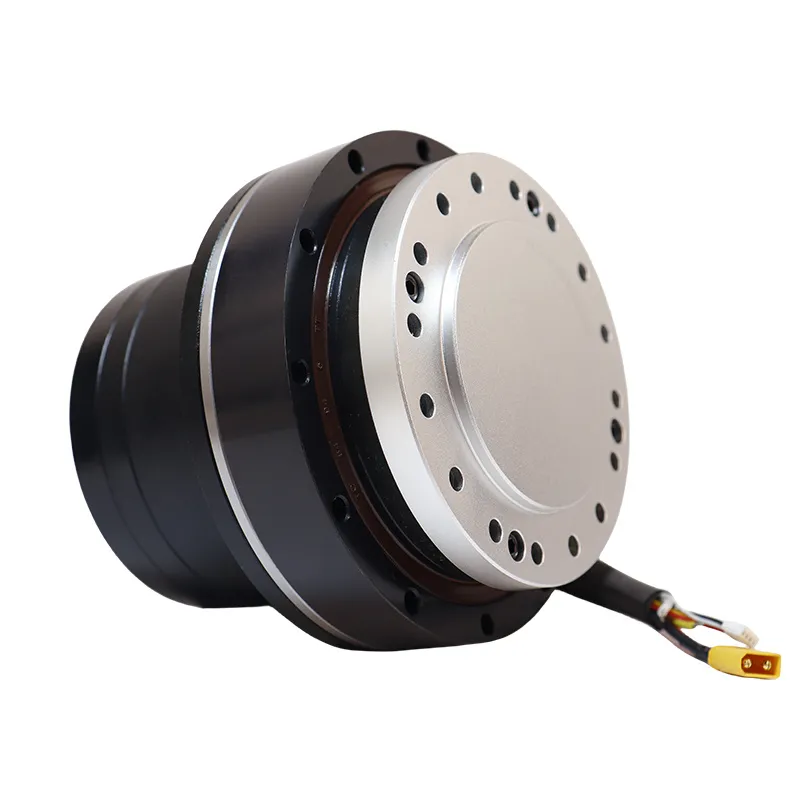
The ZHR-H Series Harmonic Joint Motor is engineered specifically for these demands. It integrates a high-torque frameless motor, dual absolute encoders, and a precision harmonic reducer into a single housed unit. With an EtherCAT communication layer updating at 4000Hz, it provides the deterministic, zero-backlash performance required for the next generation of safe collaborative robotics.