Quick answer: Robot joint motors require high torque-to-inertia ratios, hollow-shaft design for internal cable routing, high thermal efficiency, and tight integration with precision reducers. When selecting joint motors, evaluate continuous torque, peak torque, encoder resolution (dual-loop absolute), communication bus (EtherCAT/CANopen), and mechanical backdrivability.
Key Takeaways (TL;DR)
Robot joint motors form the musculoskeletal system of advanced automata (humanoids, cobots, exoskeletons). Empirical data shows that selecting frameless torque motors paired with strain wave gears (rather than housed industrial motors) improves torque density to >30 Nm/kg and eliminates kinematic dead-zones (<20 arcsec backlash). This guide provides a complete blueprint for navigating the Frameless vs. Housed debate, calculating joint motor specifications, and standardizing EtherCAT architectures.
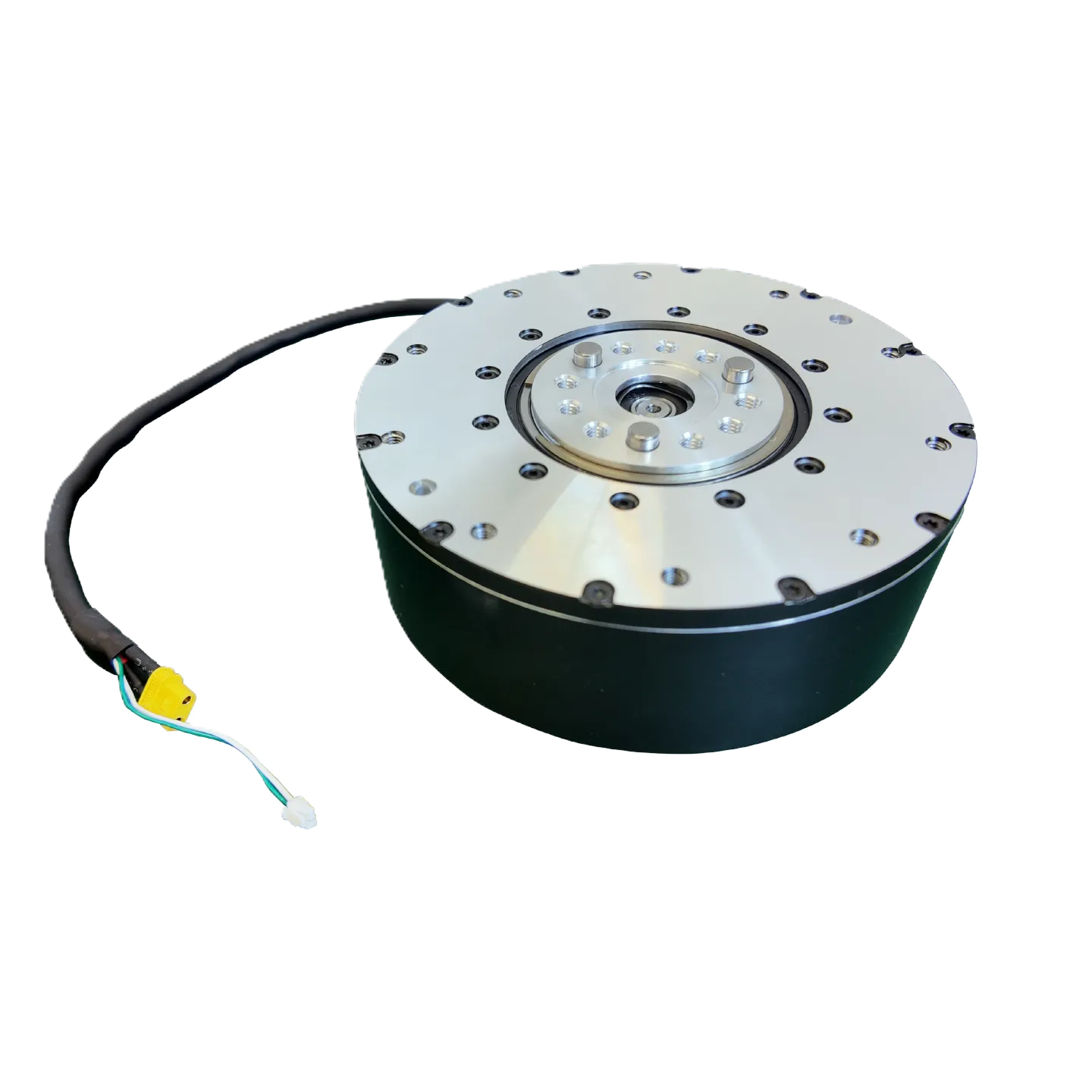
1. What is a Joint Motor in Modern Robotics-
In the era of humanoid robotics, a "joint motor" no longer refers to a simple DC servo hanging off a chassis. A modern robotic joint actuator is a highly integrated, ultra-compact electromechanical assembly designed to fit directly within the anatomical envelope of a robot's shoulder, hip, or knee.
A state-of-the-art joint motor module natively consists of four embedded layers:
- Electromagnetic Layer: Typically a high-pole-count brushless frameless torque motor, prioritized for high Km (motor constant) rather than raw RPM.
- Mechanical Reduction Layer: A zero-backlash strain wave gear (or precision planetary gearbox for high-impact joints) to multiply torque 50x to 160x.
- Sensing Layer: Dual absolute encoders (one on the motor rotor for commutation, one on the output shaft for true position and deflection measurement).
- Control Layer: A built-in PCB servo drive supporting EtherCAT or CANopen protocols, executing 1,000+ Hz torque control loops right at the joint.
2. Core Architectural Debate: Frameless vs. Housed Joint Motors
The most critical initial decision for any robotics hardware team is whether to buy raw components (frameless motors) and engineer the joint from scratch, or purchase fully integrated housed joint modules.
| Criteria | Frameless Torque Motors (DIY) | Integrated Housed Modules (e.g., ZHR-H Series) |
|---|---|---|
| Engineering Effort | Extremely High. Requires designing custom cross-roller bearings, thermal shunts, and micro-tolerance alignments for the gear mesh. | Low. Plug-and-play. Connect 48V power and EtherCAT communications to begin motion profiling. |
| Weight & Volume | Can achieve the absolute lowest weight, as the robot's structural skeleton can act as the motor housing. | Adds roughly 10-15% mass due to the module's independent outer aluminum/titanium casing. |
| Supply Chain Risk | Requires sourcing rotors, stators, gears, encoders, and drives from 4-5 different niche vendors. | Single SKU procurement. Guaranteed torque and lifecycle specifications under one warranty. |
| Time to Market | 12 - 18 months for prototype stabilization. | 1 - 3 months. |
The ZHR Engineering Verdict:
For companies whose core IP is software, AI algorithms, or high-level humanoid kinematics, building joints from frameless motors is a dangerous distraction. Using integrated housed modules like the ZHR-H series provides immediate access to world-class torque density (up to 36 Nm/kg) without the multi-million dollar R&D burn rate associated with aerospace-grade bearing tolerancing, including the Xiaomi CyberGear micro motor for research and light-duty applications.
3. Evaluating Torque Density (Nm/kg) in Joint Actuators
In humanoid robotics, gravity is the enemy. A heavy shoulder joint demands exponential torque from the hip joint simply to hold the robot upright. Therefore, Torque Density (Nm/kg)—specifically Peak Output Torque divided by Total Module Mass — is the golden metric for robot joint motors.
- Legacy Industrial Servos: Typically yield ~10-15 Nm/kg. Entirely unusable for dynamic legged locomotion.
- Cobot Joints (1st Gen): Average ~20-25 Nm/kg, sufficient for slow manipulation but inadequate for jumping or running.
- Advanced Humanoid Joint Motors (ZHR-H standard): Capable of >30 Nm/kg to 40 Nm/kg. For example, the ZHR-H17 weighs just 1.0 kg but produces 43 Nm of peak torque (33 Nm/kg).
4. Reducer Integration: Why Mechanical Architecture Matters
A high-torque frameless motor is useless without a precision speed reducer. The two primary paths dictate the joint's physical behavior:
Strain Wave Gears
Often referred to generically as harmonic reducers, these rely on the elastic deformation of a flexspline. They are absolute requirements for arms and wrists.
- Zero Backlash (<20 arcsec)
- Extreme Torque-to-Weight
- Vulnerable to extreme impulse shock
Precision Planetary Gears
Used in the hips and knees of high-velocity bipeds (like Atlas or Digit) where the robot will endure frequent foot-strike impacts and falls.
- 300% peak shock tolerance
- Highly back-drivable
- Inherent backlash (usually 3-7 arcmin)
5. The Communication Layer: EtherCAT over CAN
A humanoid robot with 40 degree-of-freedom joints requires massive data bandwidth to maintain whole-body control algorithms (WBC) processing at 500 Hz or higher. While CANopen is sufficient for quadruped robotic dogs, authentic humanoid applications are overwhelmingly migrating to EtherCAT. ZHR joint modules support dual-channel EtherCAT with standard CiA402 profiles, ensuring micro-second synchronization across all limb actuators simultaneously.
Looking for actuators that actually meet these Nm/kg benchmarks?
Check out the ZHR-H Series (up to 122 Nm/kg) with <5 arcsec backlash. Available for OEM sampling.
Looking for actuators that actually meet these Nm/kg benchmarks?
Check out the ZHR-H Series (up to 122 Nm/kg) with <5 arcsec backlash. Available for OEM sampling.
Next Steps in Joint Engineering
Now that you understand the macro-level architecture of humanoid joint motors, dive deeper into the mathematical calculations for your specific robot build:
Ready to Source Robot Joint Actuators?
Submit your required peak torque and space constraints. We'll match you with the exact ZHR-H or ZHR-P series module within hours.
Need Help Choosing the Right Actuator?
Schedule a free 30-minute technical consultation with our engineers. We'll analyze your application requirements and recommend the optimal solution.
Contact Engineering TeamFind the Right Actuator for Your Robot
Use the ZHR Product Selector to choose the ideal joint module for your specific application — humanoid, cobot, industrial, or quadruped.